Modern and Islamic Lifestyle:
Building a Balanced Life in the 21st Century
Introduction:
The world is changing at an unprecedented pace. Technology, globalization, social media, artificial intelligence, and economic transformation have reshaped how people live, work, communicate, and think. Modern life offers countless opportunities for education, career development, healthcare, entrepreneurship, and global connectivity. However, it also presents challenges such as stress, materialism, loneliness, moral confusion, family breakdown, and excessive consumerism. For Muslims, the challenge is not to reject modernity but to embrace beneficial progress while remaining faithful to the teachings of Islam. Islam is a complete way of life that provides guidance for every generation, every culture, and every technological era. The Qur'an and the Sunnah of Prophet Muhammad (peace be upon him) contain timeless principles that help believers navigate changing circumstances without compromising their faith. A modern Islamic lifestyle is therefore not a contradiction. Instead, it represents a harmonious integration of faith and progress, spirituality and science, worship and work, tradition and innovation. It encourages Muslims to become productive citizens, responsible family members, ethical professionals, and compassionate human beings while maintaining a strong relationship with Allah. This article explores the concept of a modern Islamic lifestyle, discussing its principles, practical applications, and relevance in today's world.
Understanding Modern Lifestyle:
Modern lifestyle generally refers to a way of living influenced by technological advancement, urbanization, education, globalization, and scientific development. It includes: Digital communicationOnline educationRemote workSmart devicesArtificial intelligenceGlobal businessModern healthcareFinancial innovationEnvironmental awarenessPersonal developmentModern life has made many tasks easier. Information is available within seconds. Businesses operate globally. Medical treatments save millions of lives. Transportation has become faster and more efficient. Yet modernity also introduces problems: Digital addictionMental health challenges, family disconnection, materialism, loss of spirituality, environmental destruction, unethical business practices, information overload. The goal should not be abandoning modernity but learning to benefit from it responsibly.
Islam: A Complete Way of Life:
Islam is more than a religion limited to rituals. It is a comprehensive system that governs personal conduct, family life, business ethics, governance, education, health, economics, and social justice. Allah says in the Qur'an:"Today I have perfected for you your religion, completed My favor upon you, and have chosen Islam as your religion." (Qur'an 5:3)Islam teaches balance. It encourages: Worship without neglecting worldly responsibilities, earning wealth without greed, and enjoying life without extravagance. Seeking knowledge throughout life.Caring for family and society.Respecting nature.Maintaining justice and honesty. Islam does not oppose progress. Rather, it encourages useful knowledge and innovation that benefit humanity.
Faith as the Foundation:
The foundation of an Islamic lifestyle is Tawhid—the belief in the oneness of Allah.A Muslim understands that life has purpose. Wealth is a trust. Knowledge is a responsibility. Time is valuable. Every action is accountable. This worldview creates inner peace because success is measured not only by wealth but also by righteousness. Faith provides motivation to remain honest even when no one is watching.
The Importance of Daily Worship:
A modern Muslim may have meetings, deadlines, studies, and responsibilities, yet daily worship remains central.
Five Times Daily Prayers:
Prayer organizes the day. Instead of interrupting productivity, Salah creates discipline. Benefits include: Mental relaxation, Spiritual connection, Time management, Stress reduction, Self-reflection. Reading
The Qur'an:
Even reading a few verses daily strengthens faith and offers guidance for life's challenges.
Dhikr (Remembrance of Allah):
Modern life is noisy. Dhikr calms the heart and reminds believers that ultimate success comes from Allah.
Time Management in Islam:
Time is one of the greatest blessings.The Qur'an repeatedly emphasizes the importance of time.A modern Islamic lifestyle values punctuality and productivity.Good habits include: Planning the day, prioritizing prayers, setting goals, avoiding procrastination, and limiting unnecessary screen time. Successful Muslims understand that wasting time is wasting life.
Education and Lifelong Learning:
Islam highly values knowledge.The first revelation was:"Read in the name of your Lord."This demonstrates that education is central to Islamic civilization.A modern Muslim should pursue knowledge in: ScienceMedicineEngineeringEconomicsTechnologyArtificial IntelligenceIslamic StudiesLanguagesEnvironmental ScienceLearning benefits both individuals and society.
Technology in an Islamic Lifestyle:
Technology itself is neutral.Its value depends on how people use it.Technology can be used for: Learning Qur'an, Online education, Charity, Islamic lectures, Business, Productivity, Family communication. However, misuse includes: addiction, spreading misinformation, cyberbullying, viewing harmful content, and wasting time. Muslims should become responsible digital citizens.
Social Media and Character:
Social media has become part of modern life.Islam teaches responsibility in speech.Before posting online, Muslims should ask:Is it true?Is it beneficial? Is it respectful?Does it harm others?Online behavior reflects personal character. Kindness should extend to the digital world. Family: The Heart of Islamic Society. Strong families build strong communities.Islam emphasizes: Respect for parents, Love between spouses, Proper upbringing of children, Mutual consultation, Mercy, Patience. Modern careers should never replace family responsibilities. Quality family time strengthens emotional health.
Marriage in Modern Society:
Marriage is both a spiritual and social partnership. Successful Muslim marriages are built upon: Faith, Communication, Respect, Trust, Financial responsibility, and Compassion. Technology should enhance communication rather than replace genuine relationships.
Raising Children in the Digital Age:
Today's children grow up surrounded by smartphones, tablets, gaming, and social media. Parents should teach Islamic values early. Encourage reading. Monitor internet usage. Promote physical activity. Pray together. Lead by example. Children imitate actions more than words.
Career and Professional Excellence:
Islam encourages excellence (Ihsan). Muslims should become: Honest employees, Ethical entrepreneurs, Responsible leaders, and skilled professionals. The Prophet Muhammad (peace be upon him) emphasized honesty in trade. Success should never come through fraud or corruption.
Financial Responsibility:
Islam encourages lawful earning (Halal income). Financial principles include: Honest business, avoiding interest (Riba), Paying Zakat, Charity (Sadaqah), avoiding waste, and budgeting wisely. Money should become a tool for serving humanity rather than an object of worship.
Health and Wellness:
Islam values physical health. Healthy practices include: Balanced diet, Cleanliness, Exercise, Adequate sleep, and mental well-being. The Prophet (peace be upon him) encouraged moderation in eating. A healthy body supports better worship and productivity.
Mental Health:
Modern life often produces stress and anxiety. Islam addresses mental well-being through prayer, Trust in Allah (Tawakkul), Patience (Sabr), Gratitude (Shukr), and Community support. Seeking professional psychological help is compatible with Islamic principles when needed.
Environmental Responsibility:
Islam teaches stewardship of the Earth. Muslims should: Avoid pollution, conserve water, Plant trees, protect wildlife, reduce waste, and practice sustainable living. Environmental care is an act of worship when done sincerely.
Ethics in Business:
Business should benefit society. Islam forbids: fraud, bribery, exploitation, deception, and false advertising. Ethical businesses build trust and long-term success.
Community Service:
A modern Islamic lifestyle extends beyond personal worship. Muslims should contribute through: Volunteering, Charity, Education, Helping neighbors, Supporting the poor, and Disaster relief. Serving humanity earns the pleasure of Allah.
Women's Role in Modern Islamic Society:
Islam honors women as mothers, Scholars, Professionals, Entrepreneurs, and community leaders. Women may pursue education, careers, research, and leadership while observing Islamic principles. History records many accomplished Muslim women who contributed significantly to society.
Scientific Advancement:
Islam historically encouraged scientific discovery. Muslim scholars contributed to mathematics, Medicine, Astronomy, Chemistry, and Architecture. Modern Muslims should continue pursuing scientific excellence for the benefit of humanity.
Artificial Intelligence and Ethics:
Artificial Intelligence is transforming society. Muslims should use AI responsibly by respecting privacy, avoiding misinformation, preventing bias, supporting education, and increasing productivity. Technology should always remain under ethical human guidance.
Personal Development:
Islam encourages continuous self-improvement.Areas include: Character, Communication, Leadership, Emotional intelligence, Financial literacy, Spiritual growth. Every day should become an opportunity for becoming a better servant of Allah.
Challenges Facing Modern Muslims:
Modern Muslims face numerous challenges: consumer culture, identity confusion, digital distraction, peer pressure, moral relativism, and financial pressure. These challenges require strong faith, education, family support, and community engagement.
Practical Daily Routine:
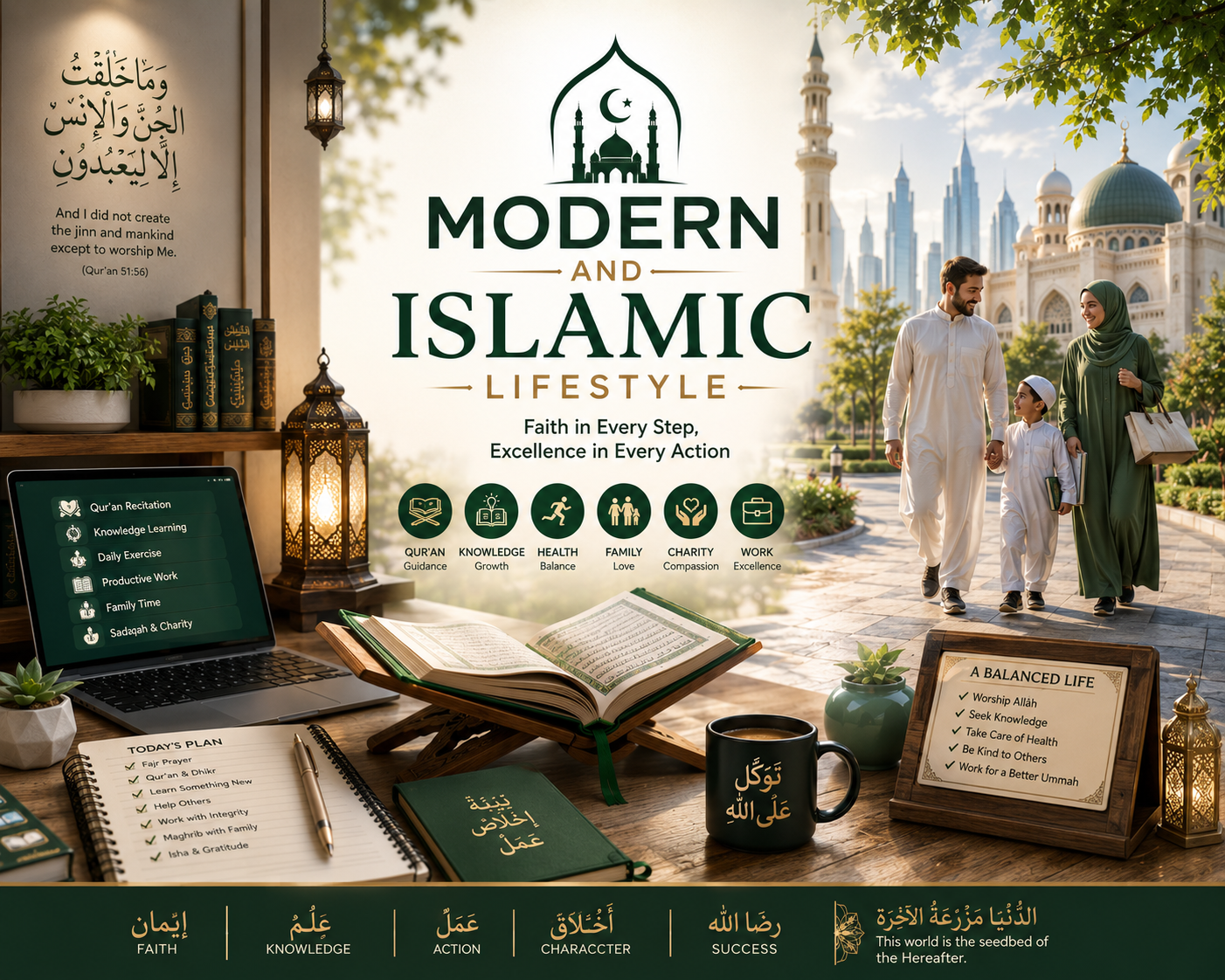
An example of a balanced modern Islamic day:
Morning:
Fajr prayer, Qur'an reading, Exercise, Healthy breakfast.
Work or Study:
Honest effort, Professional excellence, Respectful communication.
Afternoon:
Dhuhr prayer, productive work, charity when possible,
Evening:
Family dinner, Maghrib prayer, reading, planning tomorrow.
Night:
Isha prayer, reflection, gratitude, adequate sleep. Such routines combine spirituality with productivity.
Building an Islamic Digital Identity:
A Muslim's online presence should reflect Islamic values. This includes: Sharing beneficial knowledge, respecting privacy, avoiding gossip, supporting good causes, promoting kindness, and maintaining honesty. Every post leaves a digital footprint that represents one's character.
Success from an Islamic Perspective:
Modern society often measures success by: income, fame, luxury, and social status. Islam offers a broader definition. True success includes: Faith, Good character, Beneficial knowledge, Honest income, Healthy family, Community service, Preparation for the Hereafter. Material success without spiritual fulfillment remains incomplete.
The Future of Modern Islamic Living:
As technology continues to evolve through artificial intelligence, robotics, biotechnology, and digital transformation, Muslims will continue facing new ethical questions. The timeless principles of Islam—justice, honesty, mercy, moderation, and accountability—provide a reliable framework for addressing these emerging challenges. Future generations of Muslims have the opportunity to become innovators, educators, scientists, entrepreneurs, and leaders who contribute positively to humanity while remaining firmly rooted in Islamic values. By integrating faith with knowledge, tradition with innovation, and spirituality with progress, they can help build a more compassionate, ethical, and sustainable world.
Conclusion:
A modern Islamic lifestyle is not about choosing between religion and progress. It is about harmonizing both. Islam encourages believers to embrace beneficial advancements while remaining steadfast in faith and moral values. In a rapidly changing world, Muslims are called to pursue excellence in education, careers, technology, family life, and community service, all while maintaining a sincere relationship with Allah. The Qur'an and the Sunnah offer timeless guidance that enables Muslims to navigate modern challenges with wisdom and confidence. By valuing knowledge, practicing honesty, managing time effectively, caring for health, protecting the environment, and serving others, Muslims can lead balanced and meaningful lives. Ultimately, the essence of a modern Islamic lifestyle lies in living with purpose. Every action—whether studying, working, raising a family, helping a neighbor, or using technology—can become an act of worship when done with sincerity and in accordance with Islamic principles. Such a lifestyle brings not only personal fulfillment and social harmony but also hope for success in this world and the Hereafter.窗体顶端窗体底端